TINGANHO.INFO 藝術總監
TINGANHO.INFO Art Director
何庭安 Ting-An Ho
YEARBOOK 2025

Article of famous designers

TINGANHO.INFO 藝術總監
TINGANHO.INFO Art Director
Located in a neighborhood west of the
heart of Stuttgart, Germany, the Mercedes-Benz Museum exhibits the world’s first
automobile. Upon passing through the museum entrance, visitors immediately encounter
the silently looming visage of an enormous horse statue. The snide words of
Kaiser Wilhelm II, spoken during the Industrial Revolution, are engraved at the
statue’s base:
“I do believe in the horse. The automobile is no more than a transitory phenomenon.”
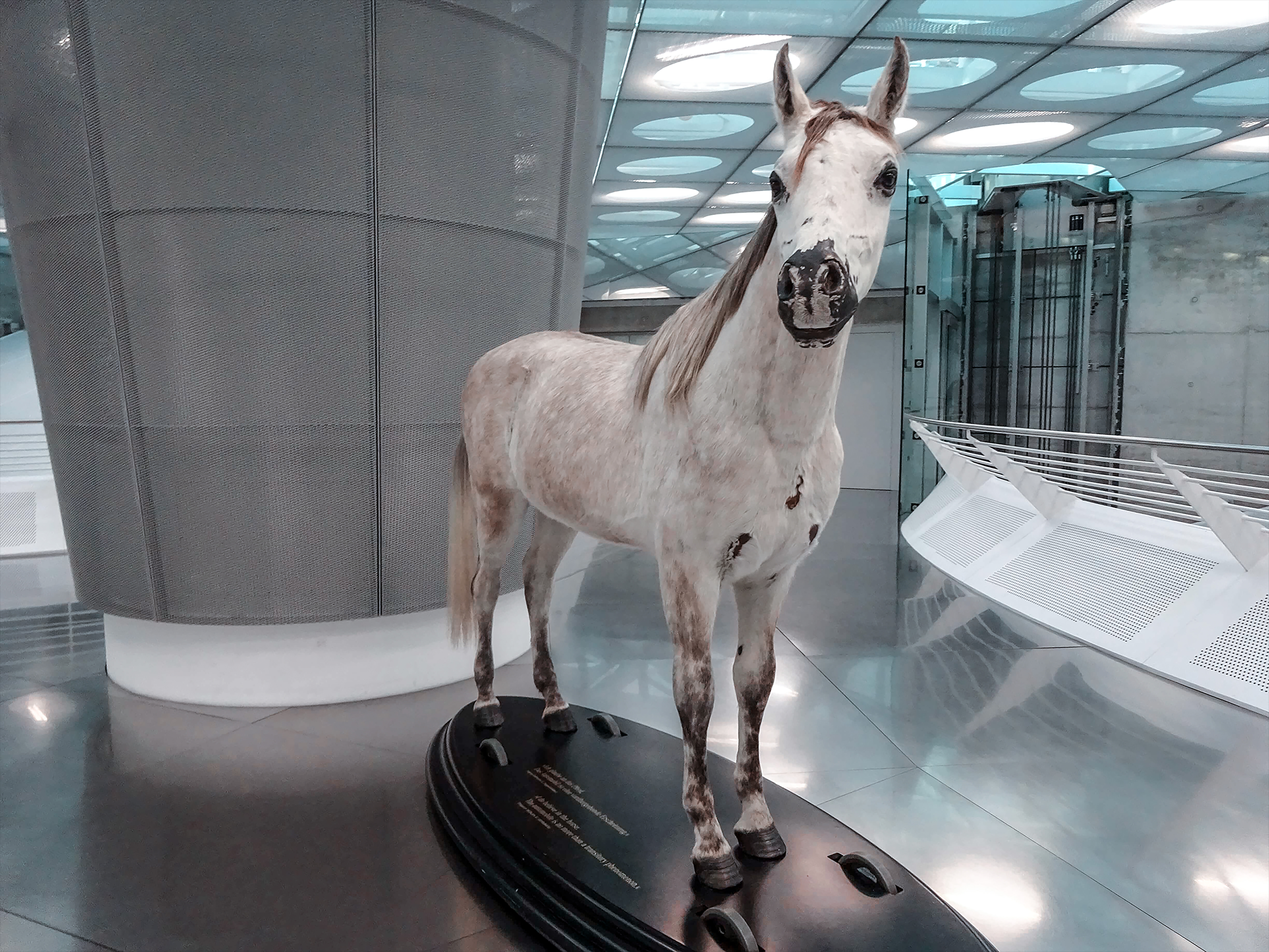
Fig. 1
This taunt is an ideal opener—not only
does it mock conservativism, it also admonishes humanity’s arrogance. When I
first visited the museum, I reacted to the Kaiser’s self-important statement
with a feeling of extreme scorn; but in hindsight, it’s as if I can sense his
panic in response to the uncontrolled technological explosion at the end of the
19th century.
Those currently reading this essay are
probably friends who are curious or passionate about design. I have no way of
knowing which era you live in, but this essay was written in early 2025, at a
time when AI was flourishing and spreading into every sector.
Perhaps in future design history textbooks,
my era will be regarded as a thriving period of computer enlightenment and emerging
artificial intelligence. However, as with many moments in design history, under
various ideological movements, an aspect that few writers will touch upon—the
part that won’t be remembered—is the global restlessness and apprehension during
this period.
I live in an era when designers are
collectively seeking “stability and purpose”. At the very least, every designer
I know has cautiously contemplated their relationship with design.
This shouldn’t come as a surprise.
Designers as a whole are bursting with talent, but we are extremely hard on ourselves.
We stand within the spectrum of creation and service, and although we have a
creator’s sensitivity, the world is constantly pulling us toward the service
end of the spectrum. However, when we truly relinquish ourselves to the service
of others, it’s as though we are reduced to aesthetic craftsmen, costing us our
souls and our self-respect.
Designers often straddle the line between business
and creation as they endeavor to produce good designs that they can present
with a clear conscience. But in the end, what is a “good design”? Even now, the
world still hasn’t given us a true standard.
Some people say that design exists to fulfill
a need; others believe design also requires artistic realization; still others equate
design to rational analysis; and yet others apply their emotions and intuition
to create lofty and praise-worthy designs. We can search online, consult our teachers,
seek advice from more accomplished peers, or even ask a chatbot, but to this
day, that divine ray of light—that “a-ha!” moment of enlightenment—continues to
elude most of us.
Designers who are just entering the field need
to contend with their clients and their clients’ clients, not to mention the
whole world’s scrutiny. It seems as if there are countless standards for
measuring whether our designs are up to snuff, encompassing everything from
quality, prestige, and market conditions to exposure. Regardless of which
standard we choose, it always seems as if our work is “not up to the standard”.
As for veteran designers, although they no
longer contend with a lack of resources, they face a different predicament:
paralysis due to the explosion of technology. Faced with brand new technology and
sage declarations from the masses that “design will soon be replaced with A.I.”,
the truth is that even accomplished peers and teachers, despite repeatedly proving
their worth, worry that they will be drowned in the tides of time.
In an era of increasingly competitive technology, the value of objects has become increasingly unstable and unknowable. In the course of my work teaching design, students have asked me, “How do we finally eliminate this anxiety? Or, what stage do we need to reach to finally at least not be this anxious? When will we feel a sense of stability and purpose?”
Fig. 2
And now, we have finally reached the core of this essay. To young designers who are barely entering the profession: There are three core skills that I hold in my heart. These skills have accompanied me throughout my journey, from my rookie years until the present day:
1. Active listening
I have
spent most of my life practicing how to listen. Listening lays the groundwork
for reflection. It is the basis for putting yourself in another person’s shoes,
and it is the best way to hone your thinking. I’ve discovered that people who
are good listeners always have an unrivaled sense of empathy, and empathy is
without a doubt a core skill for designers. Empathy allows us to fully
understand other people’s ideas, anticipate their responses, and control their
experiences through storytelling.
2. Lifelong learning
This may
sound trite, since everyone knows that we should keep learning. But there are
countless ways to learn in this world, and our own intrinsic habits may cause
us to overlook a lot of knowledge or insight. In my imagination, an expert
learner is unburdened by tools; can reflect on fragments to find answers; and
grass, trees, bamboo, and rocks can all be their teachers. Learn how to learn,
learn how to forget what you’ve learned, and learn how to relearn. These are
all learning strategies.
3. Precise expression
I don’t know for certain if this generation’s expressive ability has regressed compared to that of previous generations; however, in terms of “usefulness”, the impact of good expressive skills is greater than ever. As media has evolved from oral to online transmission, we’ve gained the ability to convey ideas at light speed, but at the same time, it is easy to be drowned out by the sea of voices. Therefore, outstanding expressive ability is akin to magic in the current era.
To summarize the above, listening, learning, and expression have helped me get to where I am today. If we truly familiarize ourselves with these three skills, it doesn’t really matter whether we are anxious. For an excellent designer, anxiety is good medicine, or rather, medicine is usually three parts poison. In fact, we are not alone in our anxieties. Designers from the past all struggled to process and move past the anxieties that characterized their own individual eras, and designers in the future will continue to do the same.
Designers have always feared that the need for design will evaporate, but design has never truly disappeared. The need for design emerged at the dawn of human civilization, and since then, it has existed in different forms across different cultures throughout different eras. Despite famines, pestilence, and war, design has never been eliminated. Has there ever truly been a pastoral era where a person only needed one skill to survive? If we reflect on the entire history of design, we’ll discover that designers have never truly been at peace.

Fig. 3
From the advent of civilization thousands
of years ago, cuneiform and hieroglyphics cultures were at odds, and had
started to challenge artisans’ selection of typeface technology. One hundred
years later, there was also the contest between papyrus and parchment paper.
Fast forward to the 10th century, the movable type printing of
Gutenberg and Bi Sheng once again impacted the history of bookmaking. Entering
the Renaissance, there was the dilemma of tempera versus fresco and water color
versus oil paint. Next came the Industrial Revolution, which we’ve already
touched on; it accelerated modernity and led to printed newspapers and
broadcasting monopolies that in turn drove postmodern reflection. That brings
us back to the current era of digital transformation, the Internet boom, and
finally, the most recent development: human–machine co-creation. Faced with
these tidal waves of change, designers have never had the luxury of complacency.
Even if every design job, every design skill,
and every piece of design software was replaced at this very moment, the terms
for these things were all invented within the past few decades. If the current
generation of students aspire to become designers, they shouldn’t succumb to
fear and discard their ambitions on account of some terms that have only existed
for a few decades. With that in mind, regarding the dilemma of whether to
engage in design, perhaps only one simple, intrinsic question remains: Do we love
design?
Do we truly love design?
I still remember the moment when I
discovered that I loved design. I was in elementary school, and I saw a movie
credit sequence designed by another person. A thought burst forth from my
brain, “This picture is ingenious! I want to draw ingenious pictures just like
this!” And just like that, I was sucked into the world of visual design. After
entering the profession, I gradually discovered all types of people whose
stories were different from my own.
Some people were moved by a beautiful work
of art. Some people were inspired by an incredible design. Some people used
design to understand how things work. Some people relied on design to tell
their own stories. Some people used design to share their interpretation of the
world. Some people used design to influence the world. Throughout their careers,
these stories quietly drove their continued progress.
The truth is, we don’t need any foundational
objective, belief, vision, or determination to engage in design; as long as we
continue to derive joy from design, that should be sufficient. Those luminary
designers whose names are recorded in the annals of history—they weren’t
necessarily the most inspired or skilled among their contemporaries, but they
were the ones with the best understanding of what they personally loved.
Perhaps in the future, we will be able to
complete truly influential design works without the need for any tools, fabricating
them whole cloth from ideas alone. But that day still is too far off for people
to forecast. And the people who elevate “ideas” above the entire creative
process, in essence, are most likely completely unfamiliar with design. Even something
as basic as a choice of the medium is the precise result of the designer
identifying the medium’s unique qualities, then fully translating and utilizing
those aspects. Through an alternating process of construction and destruction, the
designer creates a previously unknown, never before visualized, completely unexpected
aesthetic. Ideas are only one part of this process, and they are actually a
very small part.
If a day comes when all things in this
world have been permutated, combined, and pushed to their limits by designers, I
suppose that the profession of “designer” may finally be eliminated from human
civilization.
I don’t know if the readers of this
article have already arrived at that seemingly unreachable day. What are
designers in your era like? How do you regard the design practices from my era?
How does design history define or remember the era that I lived in? What kind
of statue immortalizes us?
And the design students from my generation—what kind of designers do
they become in the future?